WMTAN Forum 2026
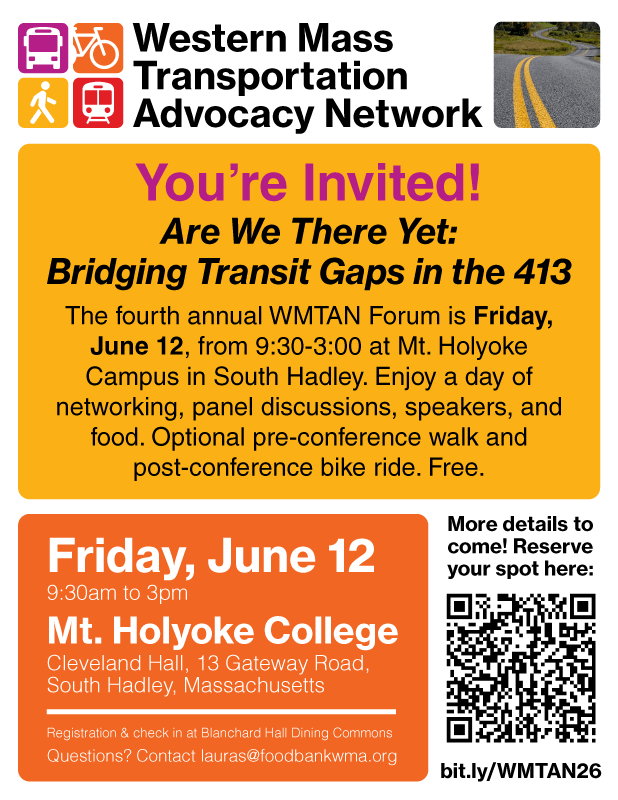
On Friday June 12th, The Food Bank and its partners in the Western Massachusetts Transportation Advocacy Network (WMTAN) hosted their fourth annual forum discussing issues and potential solutions regarding public transportation in the western half of the Commonwealth.
Western Mass Transportation Advocacy Network Forum
Friday, June 12, 9:30-3:00
Mount Holyoke College Cleveland Hall
13 Gateway Rd.
South Hadley, MA
WMTAN FORUM SCHEDULE
Campus Map: visitor parking is highlighted in red and electric car charging is highlighted in green.
8:30-9:30
Pre-Conference Walk
Optional – meet in front of Blanchard Hall Dining Commons
9:30-10:30
Check in, Breakfast, Networking
Blanchard Hall Dining Commons
10:30-10:50
Welcome Remarks from Sen. Jake Oliveira and Rep. Homar Gomez
11:00-12:30
Morning Panels – Choose one of three
Cleveland Hall, Rooms L1, L2, L3
12:30-1:30
Lunch, Networking
Blanchard Hall Dining Commons
1:30-3:00
Afternoon Panels – Choose one of three
Cleveland Hall, Rooms L1, L2, L3
Morning Panels 11:00-12:30
Cleveland Hall, Room L1
Description: Western Massachusetts strives to improve the safety of all roadway users, including pedestrians, cyclists, transit riders, and other non-motorized users. Three regional planning agencies will provide updates on their current planning initiatives to improve pedestrian crossings, protect vulnerable roadway users and provide more complete and safer streets for all.
Moderator: Ben Breger, BOWMAN. Ben is a planner and designer with over six years of experience in transportation, infrastructure, and recreation planning for local and state governments. He previously worked at MassDOT and the Town of Amherst, supporting projects across Western Massachusetts. His areas of expertise include community engagement, GIS mapping, multimodal transportation, site design, graphic design, and project management.
PANELISTS
Jessica Atwood, Director of Planning, Franklin Regional Council of Governments. Jessica has been with the FRCOG for over 30 years and oversees a 12-person department that includes planning programs in transportation, livability, energy & environment, and economic development.
Carl E. Jackson, Principal Transit Planner Pioneer Valley Planning Commission. Carl specializes in transit planning and development. He works closely with the regional transit authorities to study the efficiency of existing transit services and assess opportunities for new services.
Nicholas Russo, Senior Transportation Planner, Berkshire Regional Planning Commission. Nick’s work includes road condition pavement management, safety and performance measures, corridor planning, and bicycle and pedestrian planning.
Cleveland Hall, Room L2
Description: Springfield, Holyoke, and Easthampton residents will describe how WalkBike Springfield, the Holyoke Biking and Pedestrian Committee, and the Friends of the Manhan Rail Trail started and key advocacy and education activities. They will talk about relationships with elected officials and city officials. The panel will explore key successes and top frustrations. They will also talk about recent inter-community sharing and joint activities. We will further share the role of the statewide advocacy organizations of MassBike and WalkMassachusetts with our local groups.
Moderator: Betsy Johnson has been a community organizer for over 50 years in Boston and currently in Springfield. She worked as a teacher and for environmental and health non-profits. She was president of WalkMassachusetts and is currently a leader of WalkBike Springfield and president of her neighborhood council.
PANELISTS
Kristen Sykes is Chair of the Holyoke Bicycle and Pedestrian. When she is not biking in the CT River Valley she is advocating for National Parks in her day job at the National Parks Conservation Association. Kristen will speak about organizing bike events for local elected officials and the public.
William “Liam” Gousios has long been an evangelist for the power of the bicycle ever since getting his first real bike at 16. His first job in high school was selling bicycles, and he’s spent many further weekends helping excite and equip the next generation of riders. Liam is a member of Walk Bike Springfield, and enjoys advocating for more walkable and bikeable spaces all over the Pioneer Valley. Liam currently serves as a Board Member for the Mass DOT Bicycle and Pedestrian Advisory Board, and is currently a member of T4MA’s 2026 Champions Institute.
Alexis Hosea-Abbott first discovered rail trails on Seattle’s Burke-Gilman trail in 1996 and later realized, in 2004 when living abroad, that it was not only possible to live without a car, but was delightful. She joined MassBike in 2023 to help everyone to have a chance at that sweet sweet car-free lifestyle. She lives in Easthampton, where she enjoys walking and biking to all of her needs and most of her hobbies.
Cleveland Hall, Room L3
Description: Western Mass RTAs have been working together for the past few years to provide effective sustainable transportation across Western Massachusetts affordably and sustainably. This panel will identify successful collaborations and areas of opportunity.
Moderator: Rich Parr, Senior Research Director, The MassINC Polling Group. Rich runs MassINC Polling Group’s office in Western Massachusetts, and oversees most of their work on transportation, climate, and housing topics. He also works on data visualization and mapping, and he has co-authored pieces for WBUR, NHPR, and CommonWealth Beacon. His work on election results has been cited in the Atlantic, the Washington Post, and the Boston Globe.
PANELISTS
Paul Burns is the Director of Transit Operations for the PVTA since April 2019 with a master’s degree in public administration. Prior to working at PVTA I ran the Employment Supports program for a local non-profit with a significant focus on improving employment outcomes and transportation access for marginalized individuals in the Greater Springfield area. Significant local government experience in elected and appointed office in Western Mass including as Town Councilor, Planning Board member and Water Commissioner with a significant focus on infrastructure.
Tina Cote has been with the FRTA for over 23 years and has served as the FRTA Administrator since 2006.
Rauley Caine is with DGR Management and serves as General Manager for PVTA’s Springfield and Northampton-area depots. Rauley’s nearly 15 years of experience in public transportation includes work with operations, maintenance, and administration. He has managed fixed‑route and paratransit services, guided successful labor relations, and implemented new programs committed to stronger, rider‑focused, transit systems. He is also Project Manager for the Link413 regional partnership pilot program. Working on behalf of BRTA, FRTA, and PVTA, he helped bring about this new bus service connecting communities and Transit Authorities across Western Massachusetts.
Afternoon Panels 1:30-3:00
Cleveland Hall, Room L1
Description: Funding our transportation systems in Massachusetts is complicated, with several sources of revenue and differing needs across the state. Our panelists will break down the funding process, including transportation revenue sources, where the dollars go, and what gaps still remain. The Fair Share Amendment, or “Millionaire’s Tax,” has made new things possible in transportation, but is it enough? Panelists will discuss current transportation funding needs and will help us understand what we can do to advocate for more funding and greater regional equity in transportation spending.
Moderator: Pete Wilson, T4MA. Pete is the Senior Policy Director at Transportation for Massachusetts. Pete is a longtime communications and policy advisor who has experience in municipal and state government as well as campaign consulting. He served as the Legislative Director for the Massachusetts House Committee on Ways and Means from 2009-2011 and as press secretary and policy advisor to former Senate President Stan Rosenberg. In his free time, he enjoys downhill skiing, playing golf, cycling and spending time with his family.
PANELISTS
Carolyn Misch, AICP is the director of the City of Northampton’s Office of Planning & Sustainability and has been serving in that role since 2022. Carolyn has nearly 30 years of experience leading implementation of climate resilience, adaptation and sustainable growth principles and strategies for state, regional and local government agencies to assist in achieving equitable quality of life goals based on community values.
In 2024, Carolyn directed, on behalf of the now expanded ValleyBike share program, the relaunch of the program across 8 communities and UMass. In this relaunch, Northampton and the communities are playing a much more integrated roll to ensure success of this micromobility transportation system across the region.
Representative Tricia Farley-Bouvier is proud to represent her hometown of Pittsfield where she attended local schools, graduating from Pittsfield High School. She began her career as a teacher, earning her B.A. in Special Education from Salve Regina University in 1986 and completing her M.A. in Education at the University of Connecticut in 1991. She taught students overseas in Belize and Uruguay and worked to support Berkshire County’s immigrant population as Director of the Literacy Network of South Berkshire.
After serving four years as a City Counselor, Representative Farley-Bouvier was elected to the state legislature in October 2011. She led the years long effort to pass the landmark Work & Family Mobility Act which allows for all drivers in the commonwealth to be trained, licensed, and insured, regardless of immigration status.
Representative Farley-Bouvier currently serves as Chair of the Joint Committee on Advanced Information Technology, the Internet and Cybersecurity. She is also co-chair of the House Progressive Caucus and co-chair of the Sexual Violence Task Force of the Women’s Caucus.
Along with vigorously advocating for economic development in Pittsfield and the Berkshires, the representative’s legislative and policy priorities are: child welfare, early education, social justice, transportation, and protecting victims of sexual violence.
Phineas Baxandall, PhD is the Director of Research & Policy Analysis at the Massachusetts Budget and Policy Center where he has also served as the organization’s transportation researcher since 2015. His published transportation analysis at MassBudget has covered topics ranging from the impact of the Fair Share Amendment, the condition of the Commonwealth’s bridges, the result of fare-free policies at regional transit authorities, and sales-tax funding at the MBTA, among other topics. Before joining MassBudget, Dr. Baxandall directed the Transportation and Tax & Budget programs for the U.S. Public Interest Research Group and its network of 30 state affiliate organizations. His prior work also includes Harvard’s Kennedy School of Government, where he worked at the Taubman Center for State and Local Government and the Rappaport Institute for Greater Boston. Baxandall served as a lecturer at Harvard where he won a half dozen teaching awards. Dr. Baxandall earned a PhD from MIT in Political Science and has authored over 100 publications, including policy reports, peer-reviewed journal articles and an academic book on the political economy of unemployment.
Cleveland Hall, Room L3
Description: Recent analysis shows that rural microtransit can contribute to local economic activity in a significant way. This session examines the economic impacts of microtransit in Massachusetts, drawing on a study by the UMass Donahue Institute of the Quaboag Connector service in Ware, MA and surrounding communities.
The study estimates that for every $1 million invested, approximately $10.5 million in regional economic activity was supported. This figure reflects broader economic effects, including indirect and induced impacts in the local economy.
The panel brings together a rural transit operator, researchers from the UMass Donahue Institute, and regional practitioners, moderated by Jen Healy of the Quaboag CDC. Panelists will discuss what they suggest about the role of rural transit in supporting local economies.
The discussion will also explore how similar analyses are being extended to other rural and small-town systems, including the South County Connector in Great Barrington MA, Hilltown Easy Ride in Chesterfield MA, and Helping Our Women in Eastham MA. It will also include a brief overview of an ongoing national Transit Cooperative Research Program (TCRP) project (H-62) focused on developing a toolkit to help rural transit agencies better assess and communicate the economic impacts of their services.
Moderator: Tate Coleman serves as the Director of Public Transportation at the Town of Great Barrington, MA. Tate holds Master’s Degrees in Regional Planning (MRP) and Civil Engineering (MSCE) from the University of Massachusetts Amherst, where he served as a USDOT Dwight D. Eisenhower Graduate Transportation Fellow during the 2023-2024 academic year. Tate has worked and volunteered for the Town of Great Barrington, MA, the Berkshire Regional Transit Authority, and the Berkshire Regional Planning Commission in various capacities for nearly a decade, including as chair of the Regional Transportation Advisory Committee and a member of Great Barrington’s planning department. Tate also served for 2.5 years as the Western Region Representative to the APA-MA Board of Directors.
PANELISTS
Joan Griswold has more than 30 years of experience in supporting rural health initiatives and is dedicated to improving the well-being of rural communities. In her role at HCDC, she oversees rural transportation, supports rural health access, promotes small businesses, and provides technical assistance to these Hilltown businesses. Joan’s leadership has been instrumental in helping communities access vital services and resources, driving sustainable development, and supporting the success of local farmers and food producers.
She is a graduate of the University of Massachusetts and holds a Human Performance and Wellness degree. Joan also holds several certifications, from the Cooper Institute of Aerobic Research as Health Promotion Director, and from the American Council on Exercise as a group exercise instructor, Personal Trainer and Health Coach. She is a certified American Heart Association instructor of CPR-First Aid. Joan is Manager Level Serv Safe certified. She is also recognized as a Faculty member with the Wellness Council of America.
Branner Stewart, AICP, is a senior research manager at the UMass Donahue Institute, with 34 years of experience in regional economic analysis, transportation planning, and strategic planning for economic development. For thirteen years, Mr. Stewart was an Associate at Cambridge Systematics, Inc. specializing in economic development and transportation planning, and prior to that led economic research efforts at the Texas Department of Economic Development. Mr. Stewart is an expert on the application and derivation of economics-related data sources and is recognized for his interviewing, presentation, and analytical writing skills. Mr. Stewart has managed or has been a key staff member on numerous economic development projects, focusing on strategic industry growth, statewide and regional plans, and the economic benefits of transportation improvements. Mr. Stewart led a significant portion of the research conducted for Florida’s Strategic Plan for Economic Development for the Florida Department of Economic Opportunity, Enterprise Florida’s Rural Economic Catalyst Project, and has also played vital roles on statewide economic development efforts in Mississippi and Kansas. On a regional scale, Mr. Stewart has completed studies on the North Shore Innovation Economy for the Massachusetts Economic Development Corporation, A Better City in Boston, the Tampa Bay Partnership, and the Economic Development Research Institute in Southeast Florida. For A Better City, Mr. Stewart analyzed the linkages between transportation investment and the overall competitiveness of the Massachusetts economy. Mr. Stewart led all aspects of the recently completed Quaboag Connector Rural Microtransit Economic Impact Analysis. Mr. Stewart earned his Master of Science in Community and Regional Planning from the University of Texas at Austin and holds a B.A. in Spanish from Colby College in Waterville, Maine. He also has a professional certification, AICP, from the American Institute of Certified Planners.
Jen Healy is the Rural Transit Program Manager for Quaboag Valley Community Development Corporation, which operates the Quaboag Connector transportation service in partnership with the Town of Ware. She has a background in policy analysis and program evaluation, particularly in rural areas, and a Master’s of Public Affairs from Indiana University Bloomington’s O’Neill School of Public and Environmental Affairs.
Michael McNally is a senior research analyst at the University of Massachusetts Amherst Donahue Institute, Economic and Public Policy Research group. For the last ten years, Michael McNally has been studying the economic development of New England. Mr. McNally’s work includes studies on transportation, workforce development, housing, and education, with a primary focus on the state of Massachusetts. His research approach combines quantitative and qualitative methods. Mr. McNally has worked extensively on projects focused on the state’s rural regions. In 2025, Mr. McNally co-authored the Quaboag Connector Rural Microtransit Economic Impact Analysis which examined the socioeconomic conditions of the Quaboag Valley of Massachusetts and estimated the impacts of the Quaboag Connector microtransit service in the otherwise transit-limited region. Also in 2025, Mr. McNally helped create the Building Homes, Building Futures report in partnership with Way Finders which evaluated the state of housing across Western Massachusetts. In 2024, Mr. McNally co-authored the Engaging Hidden and Future Workers to Grow the Local Economy which examined barriers to workforce growth in North Central Massachusetts identifying transportation has a major challenge for local workers. Each of these projects has touched on the unique economic challenges of rural areas and has underlined the need for expanded transit options and economic opportunities for residents. Mr. McNally is currently working on an economic impact analysis of three different transit agencies across the state on behalf of Transportation for Massachusetts (T4MA). Michael McNally received his bachelor’s degree in economics from Saint Michael’s College in Colchester, Vermont. Mr. McNally is currently pursuing a master’s degree in regional planning from the University of Massachusetts Amherst.
Cleveland Hall, Room L2
Description: Advocates for the Valley Flyer, East–West Rail, and the Northern Tier will discuss their work to expand and improve passenger rail service in western Massachusetts, highlighting coalition-building and other effective advocacy strategies. The panel will examine opportunities to strengthen connections east to Boston, south to New York City, and west to Albany; and to expand service north to Montreal.
Moderator: Rep. Lindsay Sabadosa is the State Representative from First Hampshire District and represents the towns of Chesterfield, Cummington, Goshen, Hatfield, Plainfield, Westhampton, Williamsburg, Worthington, and the city of Northampton. She is a member of the Joint Committee on Transportation and the House Committee on Ways and Means.
PANELISTS
Ben Heckscher is a co-founder of Trains In The Valley, a rail advocacy organization he launched with Zane Lumelsky in 2016. Since its founding, the group has become a leading advocate for expanded and improved passenger rail service in the Pioneer Valley, producing a widely read website and newsletter covering rail service, transportation policy, and future plans across the region. Ben is an electrical engineer by training and grew up outside Philadelphia. He lives in Hatfield with his wife, Julie, a Northampton native.
Ben Hood is a co-founder of Citizens for a Palmer Rail Stop and the Western Mass Rail Coalition. He has served as a member and chairperson of the Palmer Rail Steering Committee, and as a member of the municipal stakeholders’ steering committee formed to advise MassDOT as it developed the conceptual design for a Palmer passenger rail station. Ben serves as the Town of Palmer’s designee on the PVTA Advisory Board.
Anne Miller is a co-founder of Citizens for a Palmer Rail Stop and the Western Mass Rail Coalition. She has been a member of WMTAN since its inception in 2019 and was a recipient of Harvard’s 2012 Green Carpet Award.
Brian Forgue is the current Chair of the Chester Selectboard, and has also served as the Chair of Chester’s Finance Committee, as a member of the Gateway Regional School Committee, and as Chester’s Town Moderator. He has been a resident of the Town of Chester for 20 years, and firmly believes in the benefits of West-East Rail to the Hilltowns and Western MA more broadly.
Robert Daley is a civic leader in Chester, currently serving on the local Planning Board, Finance Committee, and as a Water Commissioner. He also represents his town regionally as a member of the Western Mass Rail Coalition and an alternate PVPC Commissioner. His past roles include Gateway Regional School District School Committee, the Chester Railway Station board of trustees, and various town advisory boards.
Richard Holzman, Ed.D. is a civic leader in Chester, currently serving as a Planning Board member, PVPC Commissioner, and a member of the Western Mass Rail Coalition. His background in municipal governance includes past roles as a town Selectman and Town Moderator. Additionally, Dr. Holzman has contributed to regional education and preservation as a former Superintendent of Schools and a Trustee for the historic Chester Railway Station.
Moe Rusly is a student at Williams College studying mathematics and environmental studies, where he serves as a Civic Innovation Fellow at the Center for Learning in Action. He leads student trips and advocacy at Williams for the Link413 regional bus service, promoting better transit connections across the Berkshires. He is also involved in advocacy efforts to restore passenger rail service on the Northern Tier Rail corridor, reconnecting the northern Berkshires to Greenfield and Boston.
Senator Jo Comerford has been the State Senator for the Hampshire, Franklin, and Worcester district since 2019. Prior to joining the legislature, Jo spent decades as a community organizer with organizations such as AFSC, MoveOn, the National Priorities Project, and the Food Bank of Western Massachusetts. Since day one of her first term in the Senate, Jo has been laser focused on efforts to restore passenger rail service on the Northern Tier Corridor in central/western Massachusetts. Her bill to launch an exploratory commission that has since returned a robust report was the first bill Jo passed in the Massachusetts Legislature.
Thank you to our generous sponsors, T4MA and the Barr Foundation!

Thank you to the WMTAN Forum Planning Team:
- Angie Gregory, Sustainability Program Manager, Miller Worley Center for the Environment, Mount Holyoke College
- Anne Miller, Citizens for a Palmer Rail Stop
- Ben Breger, Bowman
- Ben Heckscher, Trains In The Valley
- Betsy Johnson, WalkBike Springfield
- Carl Jackson, Pioneer Valley Planning Commission
- Emily Reardon, Food Bank of Western Massachusetts
- Jacqueline Velez, Director of Campaigns, Massachusetts Public Health Alliance
- Laura Sylvester, Food Bank of Western Massachusetts
- Paul Burns, PVTA
- Rachel Scott, T4MA
- Raylen Dziengelewski, T4MA
- Rich Parr, MassINC Polling Group
- Tate Coleman, Director of Public Transportation, Town of Great Barrington, MA
- Sarita Hudson, Public Health Institute of Western MA