Originally published for the Food Bank of Western Massachusetts
Affordable and reliable transportation for individuals facing food insecurity is a key concern at the Food Bank as we confront the underlying causes of hunger. A 2019 USDA study found that 46% of individuals living in the United States with low incomes and without cars live more than a half mile from a grocery store. Reliable and frequent public transportation is crucial, since the alternative involves time-consuming treks combining public buses with long walks, bike rides on busy streets, and/or costly rideshares.
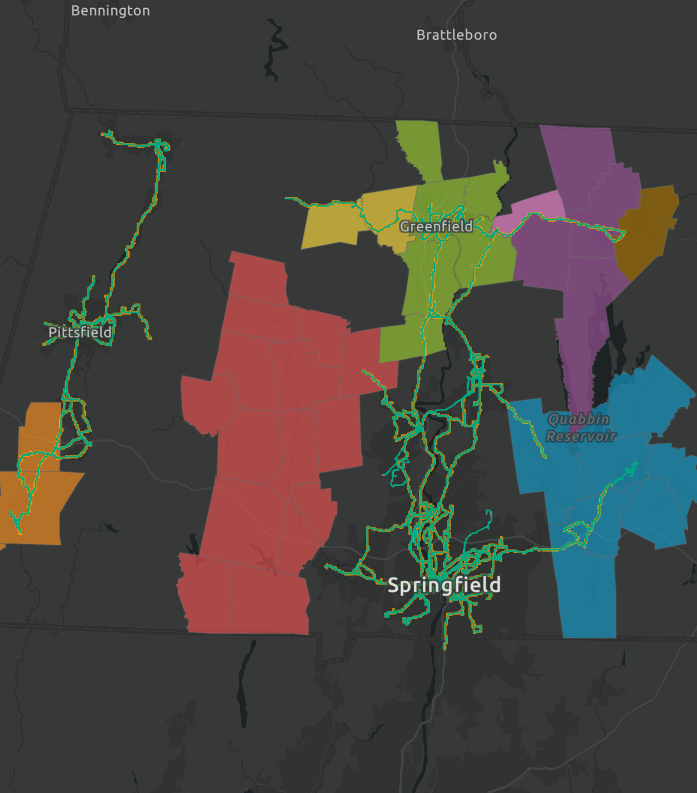
These transportation challenges extend beyond food access, creating obstacles to employment, medical care, education and more. To help identify gaps in the region’s public transportation, the Food Bank is releasing Ride WMA. This new mapping tool was commissioned by the
Food Bank, funded by Transportation 4 MA (T4MA) and Feeding America, and developed by the Pioneer Valley Planning Commission. The tool tracks the region’s public transportation options in relation to grocery stores and places of employment, higher education, and medical care.

Included in the map are the bus routes of all three major Regional Transit Authorities (RTAs) that operate in Western Massachusetts. The tool also highlights the area’s often-overlooked micro-transit options that are especially effective in rural towns.
The map can help the public better understand how well their communities are being served by public transit, answering questions like:
- How well is my neighborhood connected to jobs
with second and third shifts? - Are people in my community able to access
places for food and health care services without
a car? - If I visit my doctor’s office near the end of the
day, does the bus run late enough to take me
back home?
For advocates, finding these gaps in public transportation is crucial to demonstrate the need for funding to expand public transit. Too often, transportation funding gets stuck in a negative feedback loop that prevents necessary improvements. Inadequate services lead to low ridership, which can lead to funding cuts. Funding cuts result in route and hour cuts, which drives down ridership even more. People who rely on public transportation are then forced to cobble together increasingly fewer options to get from one place to another.
This exact phenomenon occurred on a large scale in Boston during the pandemic, but it can be harder to identify in Western Massachusetts with its dispersed geography and multiple transportation providers. The Ride WMA tool aims to break this negative cycle by visualizing the existing gaps and improving strategic planning for the future.
 WMTAN
WMTAN 